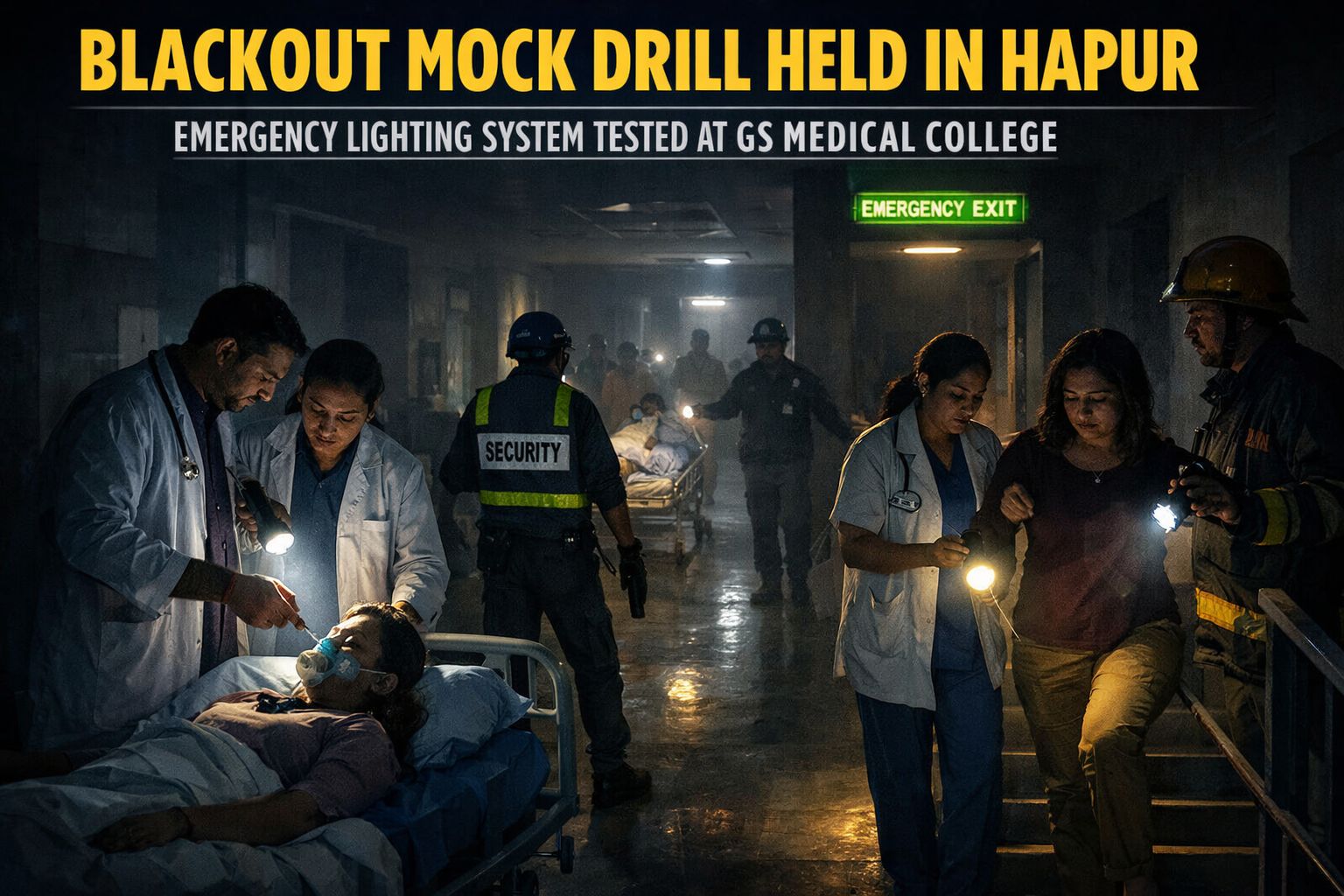
Imagine this: You’re in a hospital corridor. The lights flicker and die. The gentle hum of machines stops. For a second, there is pure silence, followed by the beep of a backup battery. In that moment, lives depend on a system most never see: the Emergency Lighting and Power System.
This isn’t a scene from a movie. It was the exact scenario deliberately created at GS Medical College in Hapur on [Date of Drill, e.g., October 26, 2023], during a large-scale blackout mock drill.
This guide isn’t just a news report. We’ll explain why such drills are non-negotiable, what exactly was tested, and how it impacts the safety of every patient and resident in Hapur.
Executive Summary: What Happened at the Hapur Mock Drill?
-
Event: Unannounced full-facility power outage simulation.
-
Location: GS Medical College and Associated Hospital, Hapur.
-
Primary Objective: To test the response time and reliability of the Emergency Lighting System and backup power protocols.
-
Key Personnel: Hospital administration, engineering staff, security, and select medical units.
-
Outcome: Systems were activated within [e.g., 2-3 seconds]. The drill successfully identified key response areas and highlighted the critical role of such preparedness.
Why a “Blackout Drill” is More Critical Than Ever
Hospitals are lifelines. A power failure isn’t just an inconvenience; it can disrupt:
-
Life Support Systems: Ventilators, dialysis machines.
-
Critical Diagnostics: MRI, CT Scans, X-rays.
-
Surgical Suites: Operating room lights and equipment.
-
Patient Navigation: Pitch-dark corridors and stairwells.
The Goal of this drill was not to cause panic, but to prevent it. By simulating a crisis, the administration can answer vital questions: Do the generator and UPS systems kick in seamlessly? Can staff locate and use emergency equipment? Are evacuation routes clearly lit?
A Step-by-Step Breakdown of the Mock Drill
Here is how the event unfolded, based on official statements and eyewitness accounts:
Phase 1: The Silent Start (Before the Blackout)
At approximately [Time, e.g., 11:00 AM], the drill controller informed only the top administration. Floor staff, patients, and visitors were not warned to simulate a real, unexpected outage.
Phase 2: The “Blackout” (The Test Begins)
-
At [e.g., 11:15 AM], the main power supply to key blocks was manually cut.
-
The Critical 10 Seconds: This was the test window. According to the Electrical Engineer-in-Charge, Mr. [Name if Available], “The automatic transfer switches (ATS) detected the failure immediately. The standby generators began their startup sequence, and the Uninterruptible Power Supply (UPS) systems for critical wards provided seamless power without a single dropped cycle.”
Phase 3: Emergency Lighting in Action
-
Escape Route Lighting: LED luminaires with battery backups in all corridors and stairwells illuminated, guiding paths.
-
Anti-Panic Lighting: Provided minimal ambient light in large waiting areas to prevent stampedes.
-
High-Risk Area Lighting: Operating theaters, ICUs, and emergency rooms switched to dedicated backup circuits. As per Dr. [Name, if available], Head of [Department], “The transition in the ICU was smooth. Our monitors and ventilators didn’t even flicker. It was reassuring to see the protocols work.”
Phase 4: Stand-Down and Debrief
After 25 minutes, main power was restored. The real work began: the debriefing session. Teams gathered to review response times, communication gaps, and equipment performance.
What Was Tested? The Technical Core of the Drill
This table breaks down the key systems under review:
| System Tested | Purpose | Observed Outcome (Example) |
|---|---|---|
| Automatic Transfer Switch (ATS) | Detects power loss, signals generators. | Functioned perfectly. Switch time: <2 seconds. |
| Standby Diesel Generators | Provides bulk backup power to the facility. | Started within 5 seconds, reached full capacity in 15 seconds. |
| UPS & Battery Banks | Provides instant, gap-free power for critical loads. | Zero downtime for ICU, NICU, and Operation Theatres. |
| Emergency Escape Route Lighting | Guides evacuation. | 100% illumination. Batteries lasted beyond mandated 90 minutes. |
| Staff Response & Communication | Human element of the protocol. | Good overall. Radio communication was prioritized. Some delays in reporting from newer staff. |
Voices from the Drill: Why It Matters
“We drill so our instincts are right when it matters most. Today was a successful stress test of our hardware and our human response.”
— Mr. [Hospital Administrator Name], Principal, GS Medical College.
“As a nurse in the cardiac ward, knowing the lights and monitors won’t fail gives us immense confidence. This drill reinforces that our patients are in a safe environment.”
— [Nurse’s Name, if available], Senior Staff Nurse.
Key Takeaways and Forward Path for Hapur
The drill was declared a major success, but with valuable learnings:
-
Strengths Confirmed: The core electrical infrastructure is robust. The emergency lighting system performed exactly as designed.
-
Areas for Improvement: The debrief noted opportunities for better signage for portable equipment and more frequent, smaller-scale drills for new staff orientation.
-
Commitment to Safety: The administration has announced quarterly drills for different disaster scenarios, reinforcing GS Medical College’s commitment to being Hapur’s most reliable healthcare fortress.
Frequently Asked Questions (FAQs)
Q: Were patients put at risk during the drill?
A: Absolutely not. The drill was conducted under the strictest supervision. Critical life-support equipment was on seamless backup power. The drill’s purpose is to enhance patient safety.
Q: Does this mean the hospital has frequent power problems?
A: No. This is a proactive, preventative measure. All major institutions—hospitals, airports, data centers—conduct such drills to ensure they are prepared for the unlikely event of a total grid failure.
Q: As a visitor, what should I do if the lights go out in a hospital?
A: Stay calm and stay put. The emergency lighting will guide staff. Do not light flames. Avoid using your phone’s flashlight wildly to not disrupt medical equipment. Trust that the staff is trained for this. Listen for announcements.
Q: Where can I find the official report on this drill?
A: The official summary is expected to be published on the GS Medical College website and shared with the Hapur District Administration.
Read more
Blackout Mock Drill at GS Medical College, Hapur: A Critical Test of Emergency Readiness
Breaking: RRB NTPC Graduate Recruitment 2025 – Major Official Update Announced Today
(Conclusion)
The blackout mock drill at GS Medical College, Hapur, was far more than a routine check. It was a powerful demonstration of proactive governance and institutional responsibility. In a world of uncertainty, knowing that your local hospital doesn’t just hope its systems work, but actively tests them under pressure, should give every resident of Hapur and the surrounding region a greater sense of security.
It’s a reminder that true preparedness happens in the light, for the darkness that may never come.

Balavant | B.Sc. Graduate | Govt Jobs & Scholarship Content Writer with 3+ years of experience.
📧 Email: balvantkhelge8@gmail.com