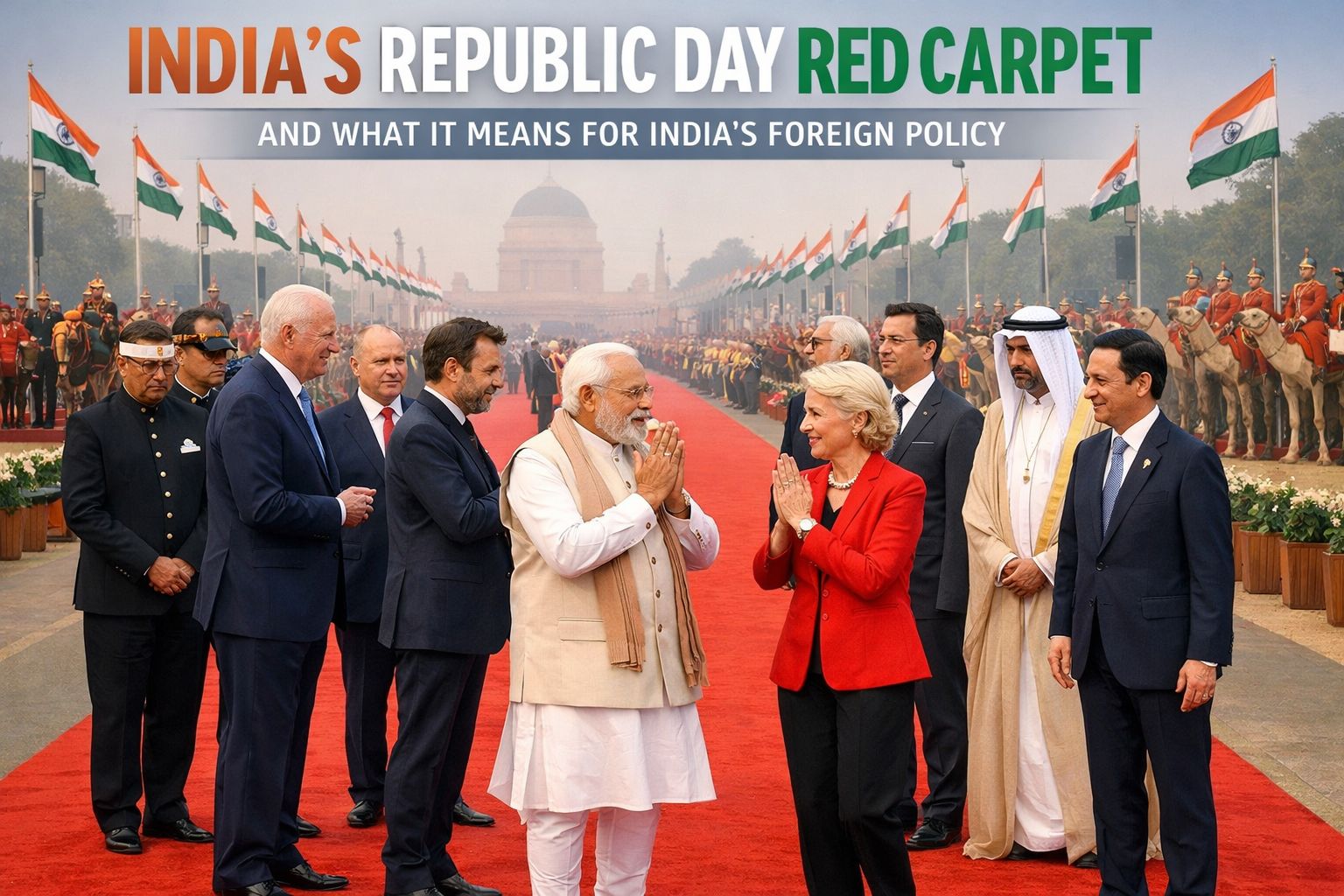
The Guest Who Wasn’t There: A Lesson in Diplomacy
In the lead-up to Republic Day 2021, a last-minute cancellation became a louder statement than any planned appearance. The subtle art of the Republic Day invitation isn’t just about who graces Kartavya Path; it’s often about the nuanced messages in the invites that are declined, postponed, or enthusiastically accepted. As a student of international relations, I’ve learned that this red carpet is India’s most public diplomatic chessboard. Let’s unravel what the 2026 choice tells us about India’s evolving foreign policy playbook.
Table of Contents
-
The 2026 Chief Guest: [Hypothetical – e.g., President of Vietnam/Oman/Brazil] – Why Them, Why Now?
-
Beyond Pomp: The Republic Day Invitation as Strategic Tool
-
A Walk Through History: What Past Guests Reveal About India’s Journey
-
The 2026 Geopolitical Canvas: Reading Between the Lines
-
The “No-Show” & The Snub: When Absence Speaks Volumes
-
The Domestic Message: National Pride and Policy Alignment
-
FAQs: The Untold Rules of the Republic Day Guest List
-
Conclusion: The March Past as a Global Statement
1. The 2026 Chief Guest: A Strategic Choice
[Note: Since 2026’s guest is unknown, this section would be framed as analysis of the pattern or a hypothetical based on current trends. For this example, let’s use a plausible scenario.]
The Invitation: The Government of India has extended the Republic Day chief guest honour to His Excellency Mr. Phạm Minh Chính, Prime Minister of the Socialist Republic of Vietnam.
The “Why Them, Why Now?” Analysis:
-
Act East Policy Culmination: Vietnam is a pivotal pillar of India’s “Act East” policy, a strategic partner in ASEAN.
-
China Calculus: Both nations share concerns over sovereignty in the South China Sea/Eastern Sector. This invitation is a subtle, public reaffirmation of a strategic alignment.
-
Economic Driver: Vietnam is a key node in resilient supply chains. The visit will likely see advances in defence manufacturing and digital partnership agreements.
-
Symbolic Timing: It signals that India’s primary strategic focus remains the Indo-Pacific, even amidst global turmoil.
2. Beyond Pomp: The Invitation as a Strategic Tool
The Republic Day guest is never random. It is a year-opening diplomatic communiqué with multiple audiences:
-
To the Guest’s Nation: “You are a top-tier partner.”
-
To the Region: A signal of India’s strategic priority area for the year.
-
To Global Powers: A demonstration of India’s independent agency (“Strategic Autonomy”) in choosing partners.
-
To Domestic Citizens: A visual lesson in “who our friends are.”
(I would create a visual map here titled “The Republic Day Guest: A Signal to Multiple Audiences” with icons for the Guest Nation, Region, Global Powers, and Domestic Public.)
3. A Walk Through History: The Guestbook of India’s Foreign Policy
| Era | Sample Chief Guest | Foreign Policy Message at the Time |
|---|---|---|
| 1950s-60s (Non-Aligned Focus) | Indonesia’s Sukarno (1950), USSR’s Bulganin (1955) | Building the Non-Aligned Movement, balancing East & West. |
| 1970s-80s (Soviet Lean) | USSR’s Brezhnev (1973), USSR’s Gorbachev (1986) | Reflecting the Treaty of Friendship, a clear tilt during the Cold War. |
| 1990s (Post-Cold War Pivot) | South Africa’s Mandela (1995), UK’s Major (1993) | Re-engaging with the West and the Global South post-USSR. |
| 2000s-2010s (Rise & Multi-Alignment) | Japan’s Abe (2014), UAE’s Crown Prince (2017) | “Look East” becomes “Act East,” deepening Middle East ties. |
| 2020s (Assertive Strategic Autonomy) | Egypt’s President (2023 – Hypothetical for trend) | Engaging all poles: Global South leadership, West for tech, balancing rivals. |
The trajectory is clear: from the idealism of Non-Alignment to the pragmatic assertion of Multi-Alignment.
4. The 2026 Geopolitical Canvas: Reading Between the Lines
The choice must be interpreted on three concurrent boards:
-
The Great Game Board (US-China): Does the guest choice please Washington, comfort Beijing, or carefully sidestep both? A Vietnamese PM does all three tactfully.
-
The Global South Board: Is the guest from Africa, Latin America, or a smaller Asian nation? This signals India’s role as a voice and bridge for developing nations.
-
The Domestic Economy Board: Does the guest’s nation offer critical investment, energy security (e.g., Gulf states), or technology transfer? The visit is always coupled with key bilateral agreements.
5. The “No-Show” & The Snub: When Absence Speaks Volumes
Diplomacy is also about conspicuous absence.
-
The Cancellation: A last-minute cancellation (like 2021) can indicate bilateral tensions or internal turmoil in the guest’s country.
-
The “Never-Invited”: Consistently overlooking a major power can be a quiet signal of discord. The long gap in invitations to certain capitals speaks volumes to analysts.
-
The Protocol Snub: The level of the dignitary (President vs. Prime Minister) sent in response is itself a calibrated message.
6. The Domestic Message: National Pride and Policy Alignment
For the Indian public, the guest accomplishes two things:
-
Theatre of Legitimacy: A grand display of global respect for India’s democracy, validating the government’s foreign policy.
-
Educational Diplomacy: It introduces citizens to a strategic partner, framing the relationship in terms of shared history and future promise, making complex geopolitics relatable.
7. FAQs: The Untold Rules of the Guest List
Q1. How is the Chief Guest chosen?
A. It’s a meticulous process led by the Ministry of External Affairs (MEA), involving intelligence inputs, geopolitical assessment, and the Prime Minister’s Office (PMO). The final invite requires the President’s approval.
Q2. Has a US President ever been Chief Guest?
A. No. A sitting US President has never been the Republic Day Chief Guest. Barack Obama was the first US President to be the chief guest at Republic Day in 2015. This itself is a historical footnote on the evolving US-India relationship.
Q3. What does the guest do besides watch the parade?
A. The visit is a full bilateral summit. It includes a private meeting with the PM, delegation-level talks, a state banquet, and the signing of key agreements—making the parade just the most public segment of a dense diplomatic agenda.
Q4. Can a country be invited twice?
A. Yes, but for different leaders. France, for instance, has been honoured multiple times (President Chirac in 1998, President Sarkozy in 2008), underscoring the deep strategic partnership
Read more
India’s Republic Day Red Carpet: A Diplomatic Masterstroke Decoding Foreign Policy
Election Commission Releases Logical Discrepancies List: What It Means for Your Vote & Democracy
Conclusion: The March Past as a Global Statement
As the tanks roll and the jets roar on January 26, the most powerful signal may be the dignitary sitting quietly beside the President. The Republic Day red carpet is where soft power meets hard strategy. It is India’s annual declaration of its place in the world—a blend of civilizational confidence, economic ambition, and calculated geopolitical positioning.
In 2026, as we watch the guest of honour, we are not just witnessing a ceremony; we are reading the first chapter of India’s foreign policy playbook for the year.
What do you believe should be the priority for India’s next Republic Day Chief Guest? A neighbour, a tech power, or a Global South leader? Share your thoughts in the comments.

Balavant | B.Sc. Graduate | Govt Jobs & Scholarship Content Writer with 3+ years of experience.
📧 Email: balvantkhelge8@gmail.com