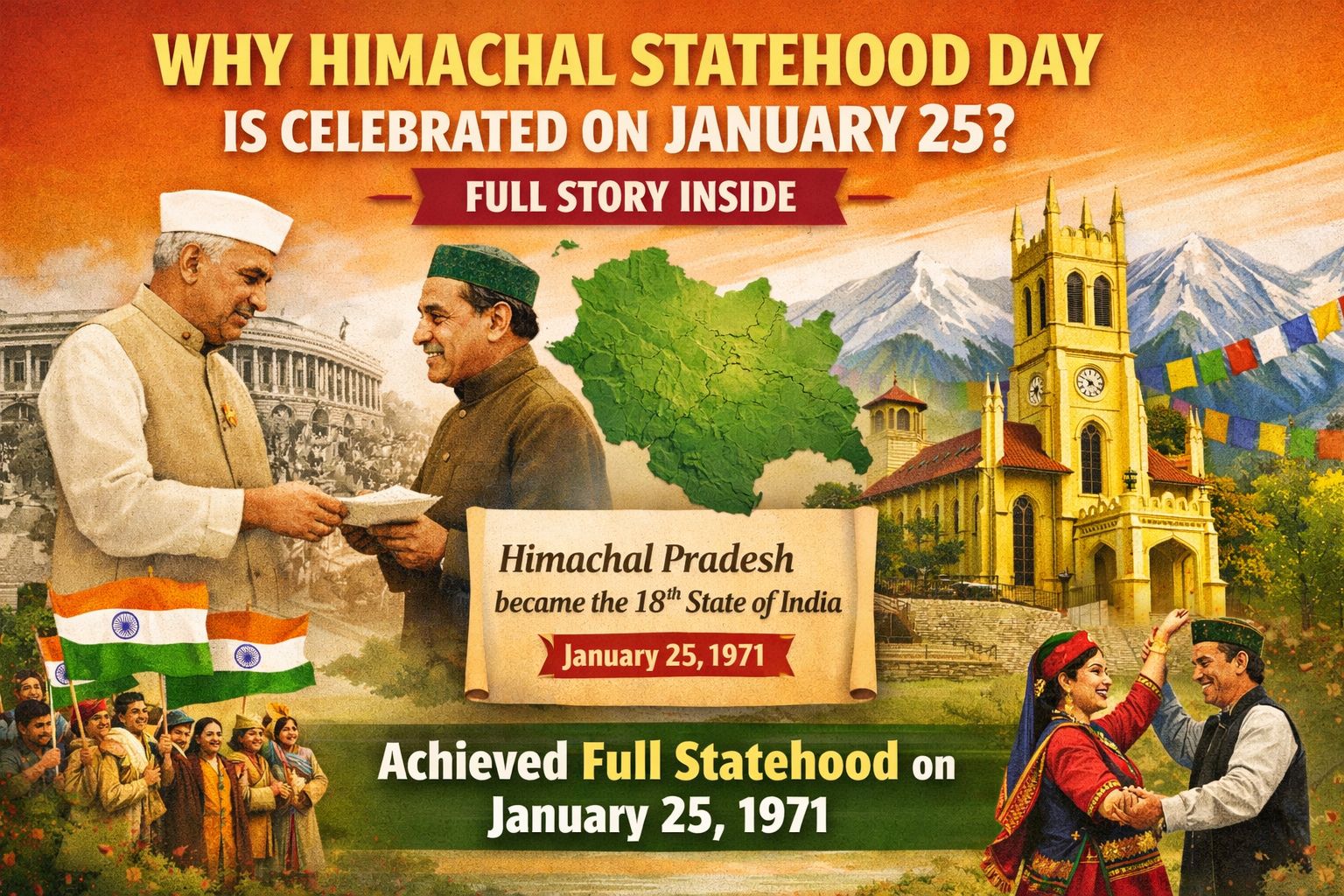
If you’ve ever wondered why the majestic mountains of Himachal Pradesh ring with celebration every January 25th, you’re not alone. The date seems specific, almost arbitrary. Was it a random choice, or does it mark a pivotal moment in India’s political history?
The truth is more fascinating than you might think. January 25 isn’t just a date on the calendar; it’s the culmination of a decades-long struggle for identity, a story of merging princely states, visionary leaders, and a final, decisive signature.
In this article, we won’t just give you the date. We’ll take you inside the full story—from the era of hill chieftains to the final act of Parliament—to understand exactly why January 25 was chosen as Himachal Pradesh Statehood Day.
[Thought: Starts with a relatable question, creates curiosity, makes a direct promise (“we’ll take you inside the full story”), and establishes the article’s unique value: context and narrative, not just facts.]
The Backdrop: Before Himachal Was a State
To understand the significance of January 25, we must first look at what came before. Before 1971, the map of this region looked very different.
-
The Era of Princely States: The area now known as Himachal was a patchwork of 30-odd independent hill states (like Chamba, Bilaspur, Mandi, Sirmaur) under British suzerainty.
-
Post-Independence Consolidation (1948): After India gained independence in 1947, the integration of these states began. On April 15, 1948, 28 of these princely states were merged to form the Chief Commissioner’s Province of Himachal Pradesh. This was the first official entity bearing the name.
-
A “Part C” State: In 1950, with the new Indian Constitution, Himachal became a “Part C” state, centrally administered. It was not yet a full-fledged, self-governing state.
So, if the entity was created in 1948, why don’t we celebrate that day? Because statehood is about political autonomy and recognition, not just administrative creation.
The Long Road to Full Statehood: A Timeline of Key Events
The journey from a “Part C” state to a full state was a 23-year campaign. Here are the milestones:
| Year | Event | Significance |
|---|---|---|
| 1956 | Becomes a Union Territory | Gained more legislative control but was still not a full state. |
| 1966 | Punjab Reorganization Act | Added the key districts of Shimla, Kangra, Kullu, Lahaul & Spiti from Punjab. This geographical and demographic boost was a game-changer. |
| 1970 | Statehood Demand Intensifies | Widespread political and public movement, led by leaders like Dr. Yashwant Singh Parmar, gains national momentum. |
The Decisive Moment: The State of Himachal Pradesh Act, 1971
The relentless efforts finally bore fruit when the Indian Parliament passed the “State of Himachal Pradesh Act” in 1971.
But here’s the critical detail most articles miss: A bill becomes law only after receiving the President’s assent.
-
Passage by Parliament: The bill was passed by both the Lok Sabha and Rajya Sabha in December 1970.
-
The Date of Assent: President V. V. Giri gave his formal assent to the Act on January 25, 1971.
This is the unequivocal, legal answer. January 25 marks the date the law was formally enacted. It is the official “birth certificate” of Himachal Pradesh as the 18th state of the Indian Union.
Why Not the Day it Was Implemented?
The new state officially came into existence on January 25, 1971, but the administrative machinery was set up over the following months, with the first state government formed later in 1971. The date of legal creation holds more constitutional significance than the date of operational start.
How is Statehood Day Celebrated in Himachal?
Today, January 25 is a day of immense pride and jubilation across the state:
-
Official Ceremonies: The main event is held in the state capital, Shimla, where the Governor and Chief Minister hoist the national flag and address the people.
-
Parades & Cultural Shows: School children, police, and cultural troupes participate in vibrant parades showcasing Himachali folk music and dance like Nati.
-
Awards & Recognition: The state government presents awards for excellence in various fields.
-
Public Participation: Buildings are illuminated, and people across villages and towns celebrate with local fervor.
FAQs: Your Questions on Himachal Statehood Day Answered
[Thought: Using an FAQ section with proper schema is a powerhouse for SEO and user satisfaction. It captures long-tail queries.]
Q1: Who is known as the founder of Himachal Pradesh?
A: Dr. Yashwant Singh Parmar, the state’s first Chief Minister, is widely revered as the key visionary and driving force behind the campaign for full statehood. His leadership is central to the narrative.
Q2: Was Himachal Pradesh ever a part of Punjab?
A: Historically, they were separate entities (hill states vs. Punjab). However, in 1966, following the Punjab Reorganization Act, several Punjabi-speaking hill districts (like Shimla, Kangra) were merged with Himachal, significantly shaping its modern borders.
Q3: What is the state symbol or animal of Himachal Pradesh?
A: The Snow Leopard is the state animal, and the Western Tragopan (Jujurana) is the state bird—both reflecting the state’s rich ecological heritage in the Himalayas.
Read more
Why Himachal Pradesh Statehood Day is Celebrated on January 25: The Complete Historical Journey
BIEAP Inter Practical Hall Ticket 2026: Your Step-by-Step Guide to Download & Key Instructions
[Conclusion & Engagement CTA]
More Than Just a Date
Understanding why Himachal Pradesh Statehood Day is on January 25 takes us beyond a calendar event. It reveals a story of integration, identity, and democratic aspiration. It connects the dots between the 1948 merger, the 1966 territorial expansion, and the final constitutional act of 1971.
This date reminds us that maps are not just drawn—they are lived, fought for, and celebrated.
What part of Himachal’s history fascinates you the most? Is it the legacy of its princely states, the political struggle for statehood, or its rich cultural traditions? Let us know in the comments below!

Balavant | B.Sc. Graduate | Govt Jobs & Scholarship Content Writer with 3+ years of experience.
📧 Email: balvantkhelge8@gmail.com