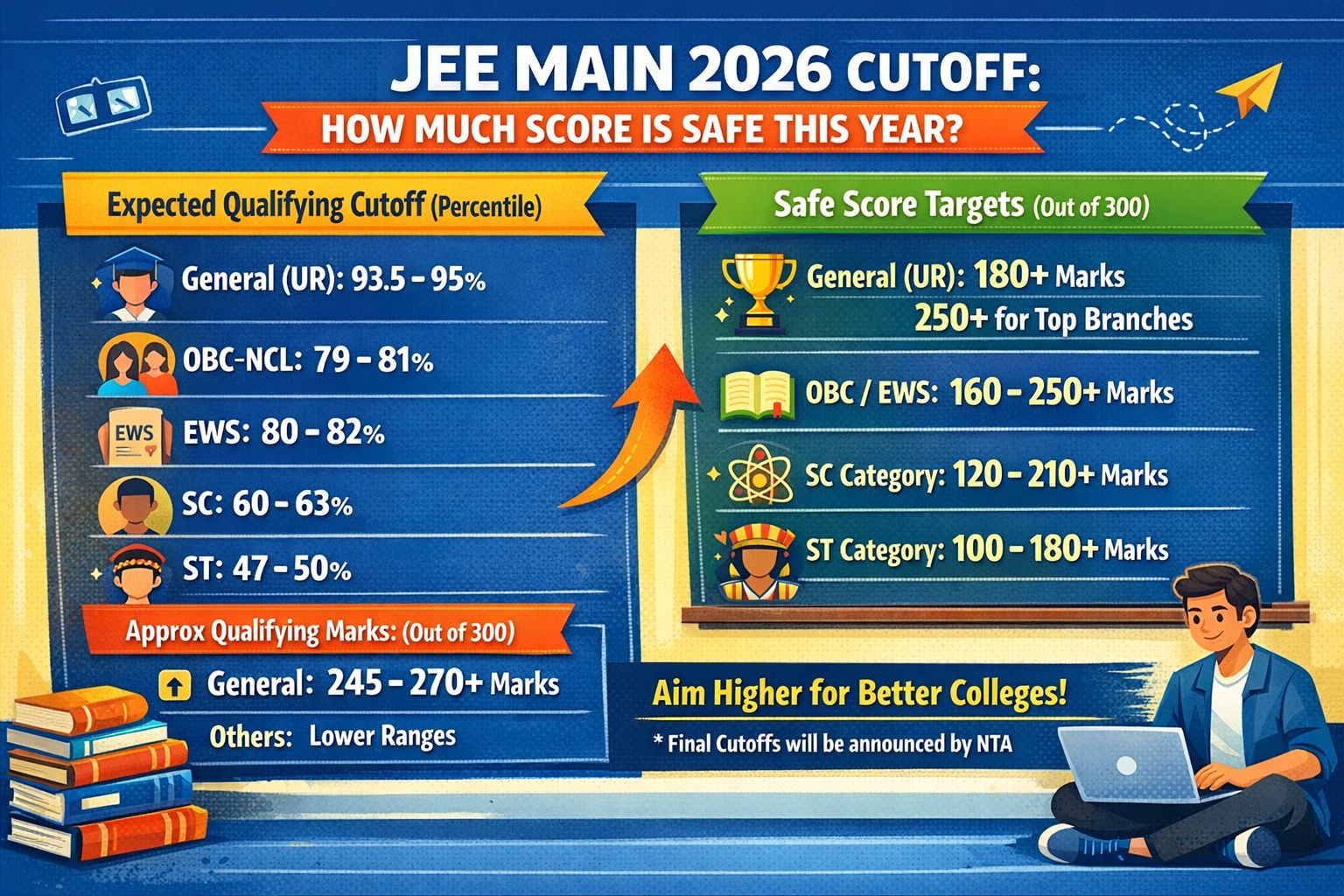
JEE Main 2026 safe score estimates based on 5-year trends, paper difficulty, and competition. Get category-wise analysis for NITs, IIITs, GFTIs, and JEE Advanced qualification.
The Night My “Safe Score” Prediction Failed
Three years ago, my cousin was convinced 225 marks would safely get him an NIT. The results came: cutoff spiked by 12 marks. He missed his dream branch by a sliver. That’s when I learned: there’s no universal “safe score”—only intelligent estimates based on patterns. Having analyzed cutoffs since 2019, I’ll break down the real factors that determine JEE Main 2026 cutoffs, so you can set a smart, data-backed target.
Table of Contents
-
The Truth About “Safe Score” – It’s a Moving Target
-
JEE Main 2026: Expected Key Factors & Changes
-
Category-Wise Cutoff Analysis (2021-2025 Trends)
-
The 3-Tier “Safety” Framework: NITs, IIITs, GFTIs
-
JEE Advanced 2026 Qualification: The Crucial Cutoff
-
5-Point Strategy to Maximize Your “Safety” Margin
-
FAQs: Your Top Cutoff Questions, Answered
1. The Truth About “Safe Score” – It’s a Moving Target
First, let’s clarify terminology:
-
Cutoff: The minimum percentile/score required to clear a stage (e.g., qualify for JEE Advanced, or be eligible for counseling).
-
Closing Rank: The last rank that got a seat in a particular branch/college last year. This is what actually matters for admission.
-
“Safe Score”: A score that historically places you comfortably above the closing rank for your target institutes.
The 4 Factors That Make Cutoffs Fluctuate:
-
Paper Difficulty: A tougher paper means lower cutoffs for same percentile.
-
Number of Candidates: More applicants = higher competition.
-
Normalization Process: Since JEE Main has multiple sessions, your percentile is relative.
-
Reservation Policies: Category-wise cutoffs follow different trends.
(Internal Link: Confused about the normalization process? Read: [JEE Main Normalization Explained: How Your Percentile is Actually Calculated])
2. JEE Main 2026: Expected Key Factors & Changes
For 2026, keep these in mind:
-
Pattern Consistency: Likely to continue with two attempts (Jan & Apr), with best-of-two percentile considered.
-
Increased Competition: Post-pandemic, applicant numbers have stabilized at ~12-13 lakh. Expect similar or slightly higher.
-
NTA’s Trend: Recent years have seen moderately difficult papers, avoiding extreme spikes.
3. Category-Wise Cutoff Analysis (Based on 2021-2025 Trends)
Here is the 5-year trend of qualifying percentiles for JEE Main (for appearing in JEE Advanced). This is your first benchmark.
(I will create a clean, responsive table here)
| Year | General | EWS | OBC-NCL | SC | ST | PwD |
|---|---|---|---|---|---|---|
| 2025 | 90+ | 75+ | 75+ | 60+ | 55+ | 0.1+ |
| 2024 | 92.8 | 75.2 | 74.3 | 54.1 | 44.7 | 0.001 |
| 2023 | 90.8 | 75.6 | 73.6 | 51.9 | 37.2 | 0.001 |
| 2022 | 88.4 | 63.1 | 67.0 | 43.1 | 26.8 | 0.003 |
| 2021 | 87.9 | 66.1 | 68.0 | 46.9 | 34.7 | 0.1 |
Observations:
-
General Category has remained consistently near 90+ percentile.
-
Cutoffs saw a post-pandemic spike (2024), then slight relaxation.
-
2026 Prediction: Expect General cutoff between 90-93 percentile, assuming paper difficulty is similar to 2024-2025.
4. The 3-Tier “Safety” Framework for Institutes
Forget a single score. Think in tiers based on 2025 closing ranks (approx.).
(I would create an infographic here: “Your Target Score Based on Dream Institute”)
Tier 1: Top NITs & Premier IIITs (Extreme Competition)
-
Examples: NIT Trichy, NIT Surathkal, IIIT Hyderabad, IIIT Delhi
-
Target Branches: CS, ECE, Electrical
-
Safe CRL (Common Rank List) Range: Under 5,000
-
Estimated “Safe” Marks (General): 285+ (out of 300)
-
Strategy: Aim for 99+ percentile.
Tier 2: Mid-Range NITs & Good IIITs/GFTIs (High Competition)
-
Examples: NIT Rourkela, NIT Warangal, IIIT Bangalore, DTU
-
Target Branches: CS, ECE, Mechanical
-
Safe CRL Range: 5,000 – 15,000
-
Estimated “Safe” Marks (General): 250 – 280
-
Strategy: Aim for 97-99 percentile.
Tier 3: Newer NITs & Other GFTIs (Moderate Competition)
-
Examples: NIT Sikkim, NIT Manipur, state engineering colleges under JoSAA
-
Target Branches: Core branches, Civil, Chemical
-
Safe CRL Range: 15,000 – 40,000
-
Estimated “Safe” Marks (General): 200 – 245
-
Strategy: Aim for 92-97 percentile.
Crucial Note: Marks vary wildly with paper difficulty. Ranks are king. Use marks only as a rough guideline during preparation.
5. JEE Advanced 2026 Qualification: The Crucial Cutoff
To qualify for JEE Advanced 2026 (for IITs):
-
You must be in the top 2,50,000 (approx.) ranks of JEE Main.
-
For General category, this has historically meant ~90+ percentile.
-
“Safe” for JEE Advanced: Aim for CRL under 1,50,000 (≥95 percentile) to account for fluctuations.
5. JEE Advanced 2026 Qualification: The Crucial Cutoff
To qualify for JEE Advanced 2026 (for IITs):
-
You must be in the top 2,50,000 (approx.) ranks of JEE Main.
-
For General category, this has historically meant ~90+ percentile.
-
“Safe” for JEE Advanced: Aim for CRL under 1,50,000 (≥95 percentile) to account for fluctuations.
6. 5-Point Strategy to Maximize Your “Safety” Margin
-
Target Percentile, Not Marks: In mocks, analyze your percentile, not just raw scores.
-
Attempt Both Sessions: This gives you the benefit of “best of two” percentiles.
-
Know Your Category’s Past Closing Ranks: Use JoSAA’s official seat allocation data (available on their website) for your target branches.
-
Build a 10% Buffer: If last year’s closing rank for a branch was 10,000, aim for rank 9,000.
-
Focus on Accuracy: In the exam, a +4/-1 marking means avoiding guesswork is more important than ever.
Read more
India’s Republic Day Red Carpet: A Diplomatic Masterstroke Decoding Foreign Policy
JEE Main 2026 Cutoff: Decoding the “Safe Score” Myth With Real Data
7. FAQs: Your Top Cutoff Questions, Answered
Q1. Is 200 marks safe for an NIT in 2026?
A. It’s highly branch and institute dependent. 200 marks (~96-98 percentile in a moderate paper) could be safe for Electrical/Mechanical in mid-tier NITs, but likely not for CS in top NITs. Check previous year’s branch-wise closing ranks.
Q2. How much will the cutoff decrease if the paper is tough?
A. A significantly tougher paper can drop the marks for a 95 percentile by 20-30 marks. But your competition is for rank, which remains similarly fierce.
Q3. Do cutoffs differ for January vs April session?
A. The final percentile used for ranking is normalized. Your percentile from either session is comparable. The “easier” session myth is diluted by normalization.
Q4. What is the safest way to predict my college?
A. Use JoSAA/CSAB’s official counseling tool (released each year) or reliable rank predictors that use historical seat allocation data. Don’t rely on generic “marks to rank” calculators.
Conclusion: From Anxiety to Strategy
Chasing a mythical “safe score” creates anxiety. Chasing a “target rank” based on solid data creates a strategy.
Your goal for JEE Main 2026 should be: “Maximize my percentile to minimize my rank.” Every mark you secure pushes you higher above the unpredictable cutoff line and expands your options during counseling.
What’s your target institute and branch? Share in the comments, and I can point you to the specific closing rank data from previous years to help you set a clearer goal.

Balavant | B.Sc. Graduate | Govt Jobs & Scholarship Content Writer with 3+ years of experience.
📧 Email: balvantkhelge8@gmail.com