

Remember that feeling when you’re cruising down the highway, favorite song on the radio, and then you glance at the gas gauge? Yeah, we might all be having that moment soon.
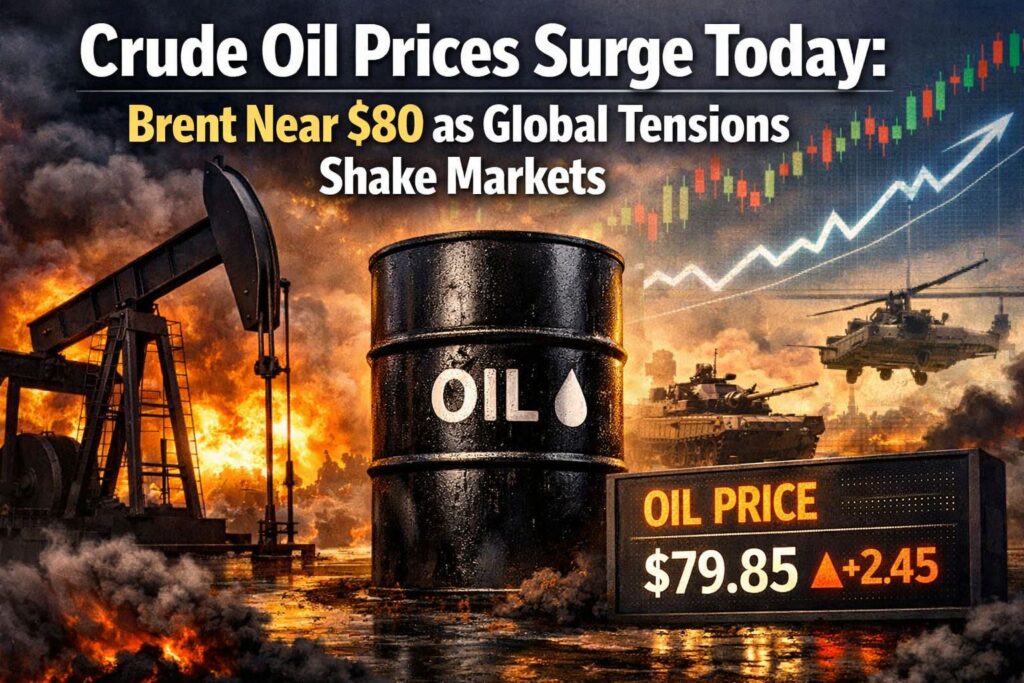
I was sipping my Sunday coffee when the news alerts started buzzing like angry bees. Brent crude had jumped more than 10% overnight. By the time I finished breakfast, it was flirting with $80 a barrel .
And honestly? This isn’t just another market fluctuation. This is the kind of spike that makes economists nervous and everyday people start calculating their commute costs.
Let me walk you through what’s actually happening, why it matters to you, and where we might be headed. No jargon, no Wall Street mystique—just the real story.
What Just Happened? The $80 Question
Oil prices surged today after escalating conflict between US-Israeli forces and Iran sent shockwaves through global energy markets .
Here’s the snapshot you need:
-
Brent crude jumped 13% to hit $82.37—its highest level in 14 months
-
West Texas Intermediate (WTI) climbed to $75.33 before settling around $71.68
-
Trading volumes went haywire as soon as markets opened Sunday evening
But here’s what those numbers don’t tell you: the fear behind them.
“This is not simply a geopolitical story,” banking expert Ajay Bagga told ANI. “It is a macroeconomic story” .
And he’s right. Because when oil moves this fast, everything else moves with it.
Why Oil Just Spiked: The Strait of Hormuz Factor
Okay, grab a mental map for a second.
Imagine a narrow stretch of water just 22 miles wide. Through that slim corridor passes nearly 20% of the world’s daily oil consumption .
That’s the Strait of Hormuz.
When Iran announced it had shut navigation through the strait following retaliatory strikes, traders didn’t wait to verify—they priced in the risk instantly .
What actually triggered this?
-
US-Israeli strikes on Iran killed Supreme Leader Ayatollah Ali Khamenei
-
Iran responded with missile barrages across the region
-
At least three oil tankers were reportedly attacked off the Gulf coast
-
Shipping giant Maersk halted transit through both the Strait of Hormuz and Suez Canal
Marine tracking sites now show tankers clustered on both sides of the strait, unwilling to risk the voyage . Insurance costs? They’ve already jumped from roughly $250,000 to $375,000 per voyage in high-risk zones .
Will Gas Prices Go Up? (The Question Everyone’s Asking)
Let me answer this straight: Yes, probably starting this week.
Here’s how it works—crude oil is the main ingredient in gasoline. When crude jumps, gas prices follow within days .
In the United States, AAA reported average gas at $2.984 per gallon just before the spike . That was Sunday morning. By Sunday evening, gasoline futures had already jumped more than 4% .
What you might see:
-
If Brent holds near $80–$90 → gradual pump price increases over 1-2 weeks
-
If Brent pushes above $100 → sharper jumps at the station
-
If conflict drags beyond 3-4 weeks → sustained higher prices
President Donald Trump suggested the attacks could last four more weeks . That timeline matters for your wallet.
Could Oil Hit $100? $120? Let’s Look at the Scenarios
I’ve read through about a dozen analyst reports so you don’t have to. Here’s what the experts are actually saying:
Scenario 1: Limited Disruption (1-3 months)
-
Bernstein’s view: Brent around $80, flipping expected surplus into deficit
-
Goldman’s take: $18 per barrel “risk premium” already baked in
Scenario 2: Strait Disruption Worsens
-
JM Financial: Crude above $90 if Hormuz flow disrupted
-
Barclays analyst Amarpreet Singh: Worst-case could push toward $100
Scenario 3: Prolonged Closure (6 months)
-
Bernstein: Brent above $110, possibly reaching recessionary territory
-
Equirus Securities: $20-$40 geopolitical premium could push crude to $95-$110+
-
Ajay Bagga: $120-$140 if maritime movement disrupted; beyond $150 if prolonged closure
The bottom line? JPMorgan analysts say if disruptions last beyond three weeks and Gulf producers exhaust storage capacity, $100-$120 Brent becomes realistic .
What This Means for Your Wallet and Investments
Here’s where it gets personal.
At the Pump and Grocery Store
Higher crude feeds into:
-
Gasoline prices (obviously)
-
Transportation costs (everything shipped by truck)
-
Grocery bills (food transport costs)
-
Airfares (jet fuel jumped, airlines stocks fell sharply)
European gas prices surged up to 28% in early trading—their biggest jump since August 2023 . German power contracts rose 3.6% .
In Your Investment Portfolio
Stocks that got hit:
-
Airlines: British Airways parent IAG fell nearly 10%, easyJet dropped 7%
-
Global markets: FTSE 100 down 1%, DAX off 2.2%, Nikkei fell 2.3%
Stocks that gained:
-
Energy companies: Exxon Mobil up 3.5% for the week, Chevron up 1.5%
-
Oil services: Baker Hughes up 43.3% year-to-date, SLB up 33.8%
-
Gold: Climbed 2.5% to around $5,408 as investors sought safety
The S&P 500 Energy sector is the top performer of 2026, up 24.4% . Meanwhile, tech stocks are down 5.6% .
The Bigger Picture: Why This Time Feels Different
I’ve covered oil spikes before. Usually, they fade.
But geopolitical expert Narendra Taneja makes an important point: the ultimate impact depends entirely on how the situation develops in the coming days . So far, Iran’s response has appeared limited, and there’s been no major disruption in actual global oil supply yet .
However, Alan Gelder at Wood Mackenzie draws a chilling parallel: “The nearest historical analogue is the Middle East oil embargo of the 1970s, which increased oil prices by 300%… Eclipsing this in today’s market seems very achievable” .
The difference today? Nearly 20% of world oil flows through that single chokepoint . And spare capacity—usually the safety valve—mostly sits behind the same strait .
What to Watch in the Coming Days
If you want to stay ahead of this story, here’s what I’m watching:
-
Strait of Hormuz traffic – Are tankers moving or idling? Marine tracking sites tell the story.
-
Statements from Saudi Arabia and UAE – Can they reroute exports through pipelines? (Limited capacity exists)
-
Iran’s next move – Escalation or de-escalation?
-
Gas prices Tuesday morning – That’s when retail starts adjusting.
Frequently Asked Questions
Why are oil prices rising today?
Brent crude surged 13% to $82 a barrel after US-Israeli strikes on Iran disrupted tanker traffic through the Strait of Hormuz. Nearly 15 million barrels per day—about 20% of global oil supply—move through that chokepoint. Even partial disruption tightens supply instantly. Traders are pricing in prolonged conflict risk and higher shipping insurance costs .
Will gas prices go up after this?
Yes, likely within days. Crude oil directly influences pump prices. Gasoline futures have already jumped more than 4%. If Brent holds near $80–$90, retail gasoline prices typically rise within days to weeks. A sustained move above $100 could push fuel costs sharply higher .
Could oil really hit $100 or $120 per barrel?
Multiple analysts see this as possible if disruptions last beyond three weeks. JPMorgan estimates Brent could reach $100–$120 if Gulf producers exhaust storage capacity. Gulf nations reliant on Hormuz have roughly 343 million barrels of onshore storage—equal to about 22 days of output. If exports stall beyond that, production cuts become unavoidable .
How does this affect me if I don’t drive much?
Higher oil prices ripple through the economy. Transportation costs affect everything you buy online (shipping), grocery prices (food transport), and airfares (jet fuel). European gas prices have already jumped 28%, and German power contracts rose 3.6%. Inflation concerns could also influence interest rates .
Is there any good news?
Some analysts note that oil spikes driven by fear often retrace once the initial shock subsides . Also, OPEC+ had already planned to increase output by 206,000 barrels per day in April . If the Strait reopens quickly and tankers start moving, some of this premium could fade.
Read more
Wanindu Hasaranga: The Sorcerer’s Apprentice Who Became Sri Lanka’s Spellbinding King
Crude Oil Prices Surge Today: Brent Near $80 as Global Tensions Shake Markets
The Bottom Line
Here’s what I tell my friends when they ask: Fill up your tank this week, but don’t panic.
Yes, oil prices surged today. Yes, Brent near $80 is significant. Yes, your gas bill might go up.
But markets are driven by fear as much as fundamentals right now. The actual oil supply hasn’t been permanently damaged. Tankers aren’t sunk—they’re just waiting. And history shows that purely “fear-driven” gaps in oil prices often retrace once the initial shock passes .
What matters is whether this conflict widens and whether the Strait of Hormuz stays effectively closed. If it does, the $100+ scenarios become real. If tensions de-escalate, we might look back at today as the peak.
Either way, I’ll be watching those marine tracking sites with you.

Balavant | B.Sc. Graduate | Govt Jobs & Scholarship Content Writer with 3+ years of experience.
📧 Email: balvantkhelge8@gmail.com